
How to Build an In-House Training Culture That Keeps Your Salon Growing
The best-performing salons don't choose between external training and in-house development. They do both — and they're intentional about what each one is for.
External training brings something that's very hard to replicate internally: fresh perspective. A guest educator walks into your salon with different influences, different experiences and a different creative eye. That kind of outside inspiration is what stops a team from getting stale, keeps clients excited, and reminds everyone why they fell in love with this industry in the first place.
But inspiration without structure fades. The stylists leave the workshop buzzing, the week gets busy, and three months later the techniques haven't been practiced, the theory hasn't been reinforced, and the energy has quietly dissolved back into the daily routine.
That's not a criticism of external training. It's just the reality of how skill-building actually works. And it's exactly where a strong in-house training culture earns its place.
The Two Things Every Salon Team Needs
Think of it in simple terms. Your team needs two things to grow:
Inspiration — the spark. New techniques, new perspectives, new creative energy. This is where external educators, industry events, platform work and guest masterclasses do their best work.
Structure — the foundation. Consistent technique, shared standards, tracked progression, ongoing repetition. This is what turns a moment of inspiration into a permanent skill. And this is where in-house training makes all the difference.
Neither works as well without the other. External training without internal structure produces fleeting enthusiasm. Internal structure without external influence produces technically consistent but creatively stagnant teams.
The goal is to build both — and to be clear about which one you're investing in at any given time.
Why In-House Training Often Gets Neglected
Most salon owners understand the value of ongoing team development in theory. In practice, it gets deprioritised. The diary fills up, quieter weeks never quite arrive, and training becomes something that happens reactively — when a problem surfaces — rather than proactively as part of the salon's rhythm.
The solution isn't more time. It's a better system.
Building a Training Culture That Actually Sticks
Start with a shared curriculum The biggest problem with informal in-house training is inconsistency. Senior stylists pass on what they know in the order they remember it, with no structure and no way of tracking progress. Junior stylists end up with gaps — not because their mentors weren't good, but because there was no map.
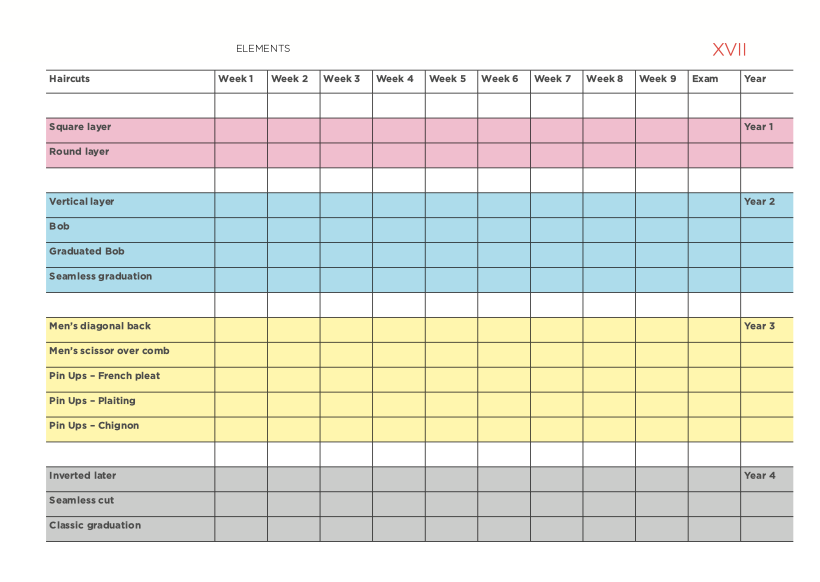
A structured curriculum fixes this. When every team member is working from the same foundation — the same techniques, the same theory, the same progression milestones — your salon's standard becomes measurable and consistent. This is exactly what the Elements Education system was designed to do, giving salon owners a 368-page framework covering 34 practical techniques and 11 theory modules, structured across four clear years of progression.
Use video to support independent learning Between mentoring sessions, junior stylists will have questions. Without a resource to turn to, they either interrupt a busy senior or guess. A library of professional video tutorials they can access on demand changes this entirely — they can rewatch a technique as many times as needed, pause at the exact moment they're unsure about, and arrive at their next check-in with specific, informed questions.
The Elements Video Programme pairs directly with the manual for exactly this purpose. For broader ongoing development, a Hairdressing Live subscription gives your team access to 130+ masterclasses across every discipline — including classes from many of the same world-class educators you'd pay significantly more to bring into the salon in person.
Build it into the week — not around it Training that gets scheduled gets done. Training that gets fitted in when there's time doesn't. Even 20 minutes a week, done consistently, compounds into significant development over the course of a year. Some formats that work well in a busy salon:
The quiet slot watch — a cancellation becomes a masterclass rather than downtime. The weekly technique focus — the whole team watches the same tutorial and discusses it briefly at the start of a shift. The monthly check-in — a 15-minute one-to-one reviewing progression and setting the focus for the next month.
Make progression visible One of the most motivating things you can do for a junior stylist is show them how far they've come. A structured tracking system — like the colour-coded progression model in the Elements manual — makes growth visible to both the stylist and the salon owner. Foundation, development, advanced: each stage has clear criteria, and moving through them becomes something to work towards rather than something that just happens passively.
How External and Internal Training Work Together
The most effective approach treats external training as the creative catalyst and internal training as the engine that converts that catalyst into lasting skill.
When a stylist attends a guest educator workshop or watches a masterclass from someone outside their usual influences, they come back with new ideas and renewed energy. Your in-house structure then gives them the space and the framework to actually practice, embed and own what they've learned — rather than letting it fade within a fortnight.
Scheduled your next external training day? Build in a follow-up internal session two weeks later where the team revisits the key techniques. That simple step doubles the return on your investment.
The Takeaway
There is no single solution — every stylist, every team and every salon is different. But the salons that grow consistently tend to share one thing: they treat education as an ongoing culture, not an occasional event.
External inspiration keeps your team creative and your clients excited. Internal structure turns that creativity into consistent, measurable skill. Build both, and you build a team that keeps getting better — week after week, year after year.
Want to see what a structured hairdressing education system looks like in practice? Explore the Elements Education programme— or browse our full library of 130+ masterclassescovering every discipline in the industry.