
How to Train Your Salon Team Without Hiring External Trainers
External training sounds great in theory. A specialist comes in, delivers a day of education, everyone leaves inspired. Then Monday morning arrives, the energy fades, and three weeks later you're not sure anyone actually retained anything useful.
The reality for most salon owners is that external training is expensive, disruptive, and inconsistent. You lose a full day of appointments, you pay a significant day rate, and the results are largely out of your hands.
There's a better way. And it doesn't require a big budget or a dedicated training manager.
Why In-House Training Works Better Than You Think
The most effective salon training happens little and often — not in one-off intensive days. Skills are built through repetition, observation and consistent feedback, not a single workshop. When training is embedded into the daily rhythm of your salon, it sticks. When it's a quarterly event, it doesn't.
The good news is that building a consistent in-house training culture is simpler than it sounds. It starts with having the right systems and the right resources in place — and then using them regularly.
Start With a Structured Curriculum
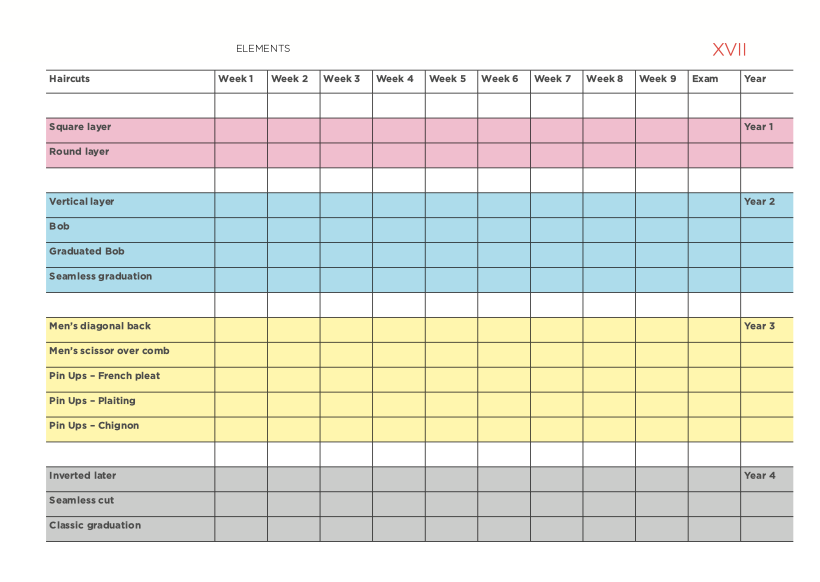
The single biggest problem with most salon training programmes is that they're informal and inconsistent. Senior stylists pass on what they know, in the order they remember it, with no real structure. Junior stylists learn different techniques from different people, with no way of tracking where they are or what they still need to cover.
A structured curriculum fixes this immediately. When every team member is working from the same foundation — the same techniques, the same theory, the same progression milestones — your salon's standard becomes consistent and measurable.
This is exactly what the Elements Education system was built to do. It gives you a 368-page manual covering 34 practical techniques and 11 theory modules, structured across four years of progression. Every team member works through the same material, at their own pace, with clear colour-coded milestones so both the stylist and the salon owner can see exactly where they are at any given time.
Use Video to Fill the Gaps Between Mentoring Sessions
One of the most underused training tools in any salon is video. When a junior stylist has a question between mentoring sessions — about a technique, an angle, a finish — they either interrupt a senior stylist mid-appointment or they guess. Neither is ideal.
Having a library of professional video tutorials your team can access on demand changes this entirely. They can watch a technique as many times as they need, pause at the exact moment they're unsure about, and come to their next mentoring session with specific, informed questions rather than vague uncertainty.
The Elements Video Programme pairs directly with the manual — 42 HD tutorials covering every technique in the book, filmed by Paul Davey and Stephen Boyle with multiple camera angles so nothing is missed. Salon owners who use it report that their junior stylists progress noticeably faster, and that senior stylists spend less time on basic troubleshooting during the working day.
For broader ongoing development beyond the Elements curriculum, a Hairdressing Live subscription gives your entire team access to 130+ masterclasses across cutting, colouring, barbering, session styling and business — for one flat monthly or annual fee.
Build Training Into the Week — Not Around It
The most common reason salon training falls apart is scheduling. It gets deprioritised when the diary fills up, pushed to quieter weeks that never quite arrive, or saved for the annual team day that ends up being more social than educational.
The salons that do this well treat training like any other appointment — it goes in the diary and it doesn't move. Even 20 minutes a week, done consistently, compounds into significant development over a year.
Some practical formats that work well in a busy salon environment:
The quiet slot watch — when a cancellation creates a gap, the stylist uses it to watch one masterclass or one tutorial chapter rather than scrolling their phone. No pressure, no assessment, just consistent exposure to good technique.
The weekly technique focus — choose one technique or topic per week across the whole team. Everyone watches the same tutorial, then discusses it briefly at the start of a shift. This builds shared language and shared standards.
The monthly skills check-in — a 15-minute one-to-one between the salon owner or senior stylist and each junior, reviewing their progression tracker and identifying what to focus on next month. Structure without bureaucracy.
Make Progression Visible
One of the most motivating things you can do for a junior stylist is show them how far they've come. When progression is invisible — when there's no record of what's been covered, no milestones to hit, no acknowledgement of advancement — training feels endless and unrewarding.
A structured tracking system, like the colour-coded progression model in the Elements manual, makes growth visible to both the stylist and the salon owner. Foundation, development, advanced — each stage has clear criteria, and moving through them becomes something to work towards rather than something that just happens passively over time.
Stylists who can see their own progress stay more engaged. Salon owners who can track their team's development make better decisions about who's ready for more client-facing responsibility.
The Cost Comparison
Let's be practical for a moment. A full day of external training for a team of five to ten stylists — including the trainer's day rate, any travel, and the lost appointment revenue — can easily cost €1,500 to €3,000 or more. And that's for a single day.
The Elements Video Programme is a one-off investment of €2,000 that covers your entire team, for as long as you're in business, with lifetime access and no recurring cost. A Hairdressing Live team subscription works out at a fraction of the cost of a single external training day per year.
The maths is straightforward. The quality of education is higher. And the flexibility to learn anytime, at your own pace, means the knowledge actually sticks.
Where to Start
If you're building a training programme from scratch, keep it simple:
First, establish a curriculum — give every team member a clear map of what they need to learn and in what order. Second, give them the tools to learn independently — video tutorials they can access on their own time are invaluable. Third, build in regular check-ins to review progress and keep momentum. Fourth, make progression visible and celebrate it when it happens.
You don't need an external trainer. You need a system, the right resources, and the consistency to see it through.
Want to see what a structured hairdressing education system looks like in practice? Explore the Elements Education programme — or browse our full library of 130+ masterclasses covering every discipline in the industry.